
Sim racing is one of those hobbies that can often feel like work. The highs are short, and the lows seem more frequent. But it’s exactly this competitive and challenging nature that keeps thousands of drivers across different platforms coming back for more. We’ve covered the basics before – the gear, what to focus on during a race but once you’ve “mastered” those fundamentals, the next step is evolution. There’s always something to tweak, improve, or optimize.
If you’re no longer a newbie, here are a few ways to start sweating for those extra tenths.
Steering vs. Rotation
We touched on this in the recent Is this the most unique iRacing tip you’ve never heard of blog, but this time it’s slightly less controversial.
Steering into a corner and rotating the car at peak grip are two very different things. The latter requires trail braking. In short, trail braking involves extending the braking zone into a corner – shifting the car’s weight forward and increasing front-end grip and rotation. It’s done through subtle steering inputs while the car’s weight is still on the nose.
How to Practice Trail Braking
Luckily, iRacing makes this easy to practice in the rookie classes. Cars like the Mazda MX-5 or FF 1600 are perfect tools for learning the basics and importance of trail braking.
Once you get the feel for it, the technique becomes part of your muscle memory. You’ll use it in almost every car and series going forward. Personally, I still spend a lot of time racing these lower-powered cars. The racing is tight, competitive, and relies purely on car control rather than aerodynamic grip.
The steering topic doesn’t end there, lets look into it more.
Steering… Continued
One of the worst things you can do in iRacing is applying more steering when the tires are already at their limit. The more frequently and violently you do it, the worse the situation becomes. To me, this is often more frustrating than what I call “ice mode” after a subtle rear-end slide.
You might not understand why it’s happening, but you’ll see it clearly on your lap times and missed apexes. So how do you fix it? First, you need to nail your trail-braking technique. Then, learn to steer with the brake pedal.
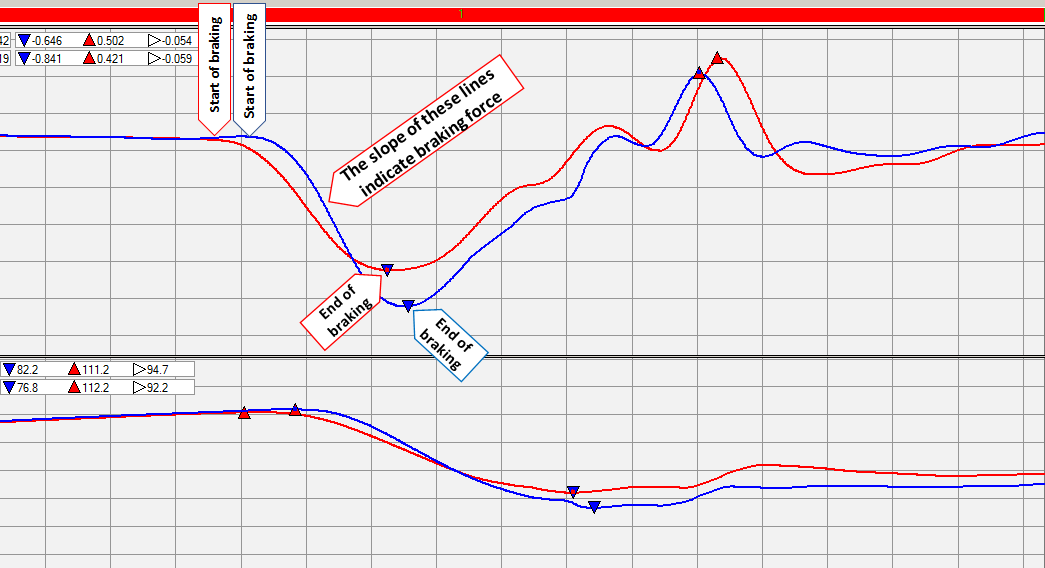
This can be seen as a “method within the method” and is also adjusted car to car. Watch high-iRating drivers and you’ll notice their brake traces aren’t super smooth always – there are subtle, tiny variations during the trail-off phase. These small modulations help the car rotate through the corner without the need to yank in more steering angle.
As much as we’d like to think driving is one smooth motion, it rarely is – especially when conditions are changing. Practice this again with the rookie cars and refine it until it becomes second nature.
Slow In, Fast Out
It’s one of the oldest driving principles, yet one most of us tend to ignore (myself included).
Overdriving and frustration often come from chasing that green delta bar. Seeing it flicker between green and red can mess with your rhythm. When that happens, take a step back and reset.
Move your braking marker back and focus on nailing your corner exit – that’s where your lap time usually hides. This principle ties back to everything above: over-driving into a corner limits your ability to manage entry balance killing exit speed.
Want To Join The Masters Grid?
We would love more drivers to join us in the series. The joining fee is minimal, and you will become a faster driver whilst enjoying the racing and getting to know some industry stalwarts in the process! More information can be found here: https://masters-series.co.za/Entry