
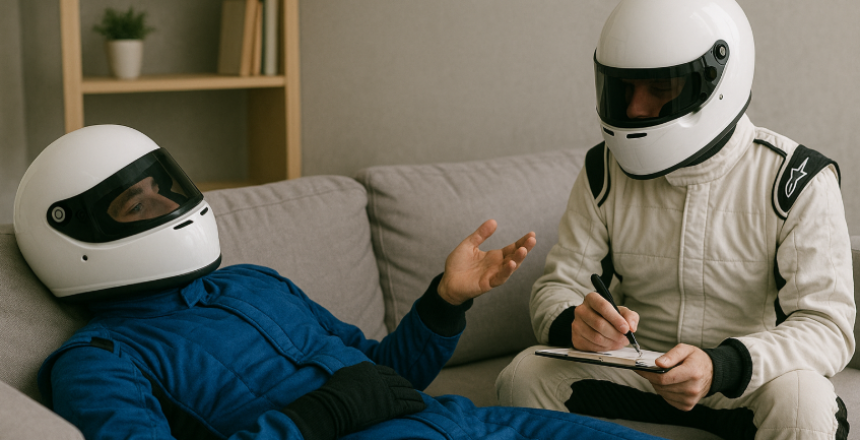
Picture this: you find yourself at the front of the pack, leading the race. Everything is going to plan. The driver behind you is on your tail, but you’re calm until suddenly, everything changes. Every movement, corner, and input becomes deliberate. Every action requires thought. Eminem’s “8 Mile” is no longer just a song in your head – your knees are weak, and your palms are sweaty. You’re no longer driving with rhythm; you’re overthinking. And then, you bottle it. The race win is gone.
Congratulations! You have just experienced the Reinvestment Theory, or in simpler terms, “paralysis by analysis.” It describes when a driver begins to consciously control movements that are usually automatic, such as braking or steering. By doing so, you prevent yourself from executing them naturally. The result? You get flustered, make mistakes, and drive slower, unable to return to that effortless flow state you often find during practice sessions. The good news is that with a few tweaks you can improve your approach to racing in situations like this. Lets look at three easy adjustments you can make.
Tweak Your Approach To Practice
Adjust you focus away from overall leaderboard or ultimate lap time as the only goal. Sure, this is important for qualifying or gaining a psychological edge, but there’s no point in setting a lap you can’t consistently repeat. Focus instead on driving smoothly and naturally. Spend time finding your rhythm, run race stints and ignore the delta bar. I would even take this a step further – keep the delta bar off during races as well.
By fostering a natural rhythm, you’ll likely improve your lap time over time, learn more efficiently, and most importantly build consistency. That’s where real performance gains come from and gives confidence in high pressure scenario’s by not obsessing over specific details.
Shadow Boxing
Like a boxer visualizing an opponent, visualize how you expect the race to unfold. Think about how you’ll react in moments of pressure, whether losing or gaining positions. Planning for these scenarios helps you manage emotions and maintain composure.
Go a step further: practice different racing lines, simulate overtakes, defend corners, and explore how the car behaves when in different scenario’s. These small exercises prepare you for real-race chaos and build adaptability under pressure.
Bring it together – Holistic Process Goal
The irony is that trying not to think about something often makes you think about it even more. That’s where the Holistic Process Goal comes in, a mental trick used by many top athletes. Instead of focusing on countless micro-goals like “brake here,” “relax your shoulders,” or “hit the apex,” replace them with a single phrase or cue that encapsulates your objective. For example:
- “Breathe” – to stay calm and smooth in qualifying
- “Keep it smooth” – to focus forward instead of worrying about who’s behind
By doing this, you stay mentally aligned and avoid overthinking during critical moments. Racing is as much a mental battle as it is a physical one. Mastering your mind under pressure, and transforming negative emotions into positive focus, might just be the key to unlocking those elusive results.
Want To Join The Masters Grid?
We would love more drivers to join us in the series. The joining fee is minimal, and you will become a faster driver whilst enjoying the racing and getting to know some industry stalwarts in the process! More information can be found here: https://masters-series.co.za/Entry